Free Press...
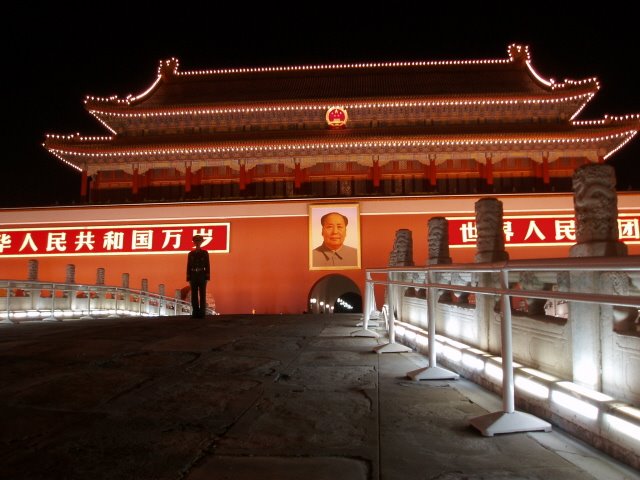
Due to the Olympic Games, China has promised that reporters would have free access to the internet. They've promised this for several years, and made the promise again only a few days before the Olympics start.
Never mind though, they still block internet access for reporters to scary sites like Amnesty International, Reporters Without Borders, dissidents, human rights, and pro-T1bet@n groups. Part of this is explained in that the officials are just following Chinese law forbidding access to such sites.
Reuters video (in English)
Read the full story (in French)
And also here (in French)
July 25, 2008
Bonnie Scotland...
 It's been a while since I've updated my blog, but a lot has happened since I left Paris. I travelled to Glasgow/Prestwick with my family. We rented a car to drive around, since it was cheaper than taking trains/buses for four people. The first adventure was my Dad driving on the other side of the road (KEEP LEFT!!!!). We visited many relatives -some we'd seen recently, some a long time ago, and others we'd never met- all over Scotland. Everyone was incredibly welcoming, and we were all stuffed full of tea, cakes, and cookies. Not even mentioning all the amazing meals we had.
Instead of trying to write about the past two weeks, I thought I'd show them briefly in a few photos.
 A view of Edinburgh
 Stirling Castle
 Loch Ness
 Whisky distillery
 Family pub/music night
 Eilean Donan Castle
 Fishing
 Gaelic/English sign in Uig
 Isle of Lewis
 Isle of Lewis
 Isle of Lewis
 Calanais standing stones (older than Stonehenge)
 Stornaway harbour
 Scottish thistle
 It's been a while since I've updated my blog, but a lot has happened since I left Paris. I travelled to Glasgow/Prestwick with my family. We rented a car to drive around, since it was cheaper than taking trains/buses for four people. The first adventure was my Dad driving on the other side of the road (KEEP LEFT!!!!). We visited many relatives -some we'd seen recently, some a long time ago, and others we'd never met- all over Scotland. Everyone was incredibly welcoming, and we were all stuffed full of tea, cakes, and cookies. Not even mentioning all the amazing meals we had.
Instead of trying to write about the past two weeks, I thought I'd show them briefly in a few photos.
 A view of Edinburgh
 Stirling Castle
 Loch Ness
 Whisky distillery
 Family pub/music night
 Eilean Donan Castle
 Fishing
 Gaelic/English sign in Uig
 Isle of Lewis
 Isle of Lewis
 Isle of Lewis
 Calanais standing stones (older than Stonehenge)
 Stornaway harbour
 Scottish thistle
July 03, 2008
Marrakesh...
 A-Ssalaam âlikum fi Mrkesh. I'd love to be able to write this post in Arabic, but clearly 3 weeks of language classes just isn't enough to become fluent in a language! I spent only 3 nights in Marrakesh, just off the Jmaâ el Fna which is the main square in Marrakesh. The 'in the shade' temperature was around 43C (109F), and in the sun it was closer to 48C (119F). Needless to say there was a lot of sweating, and even after drinking 3.5L of water and juice a day I was still thirsty.
 Marrakesh is one of the main cities in Morocco, and also the most touristed. It's clear from all the hassle given to the tourists in the souqs and main areas that people in Marrakesh are used to ('stupid') tourists. I must admit that I was able to pick out the new arrivals by the fact that 1)despite the 48C heat they continued to walk in the middle of the road instead of in the shade (where it was only 43C) and 2)the gawking that was done when a donkey would go by carrying a big load of some product. Not to say that I didn't stand out as a tourist having light skin.
 I'd been in Morocco for long enough that I was able to enjoy the cheap food at night, and the $0.30 orange juice served in the main square. I think I probably would've gotten very sick otherwise. The main square, the Jmaâ el Fna, is a hive of activity especially when the sun starts to go down, probably because it's just too hot to do anything while the sun is out. The square is full of orange juice sellers (drink with caution if you're new to Morocco), date sellers, food stalls that sell everything from tajine to harira soup to goat brain, snake charmers, musicians of all types, fortune tellers, magicians, Tuareg traders from the Sub-Sahara selling all sorts of eggs, skins, and traditional medicine, monkeys, Gnaoua musicians/dancers, story tellers, henna painters, and even a man who pulls teeth! It really is a site to behold, and continues until people leave, sometimes as late as 4AM. UNESCO has even declared the site and "Intangible Heritage Site".
Marrakesh really is a fascinating city, and I can see why it's so popular for tourists. It has the 'exotic' Orient feel, but also the Western comforts if that's what one is looking for. I'll be back to Marrakesh, and to see more of Morocco, Insha'allah.
 A-Ssalaam âlikum fi Mrkesh. I'd love to be able to write this post in Arabic, but clearly 3 weeks of language classes just isn't enough to become fluent in a language! I spent only 3 nights in Marrakesh, just off the Jmaâ el Fna which is the main square in Marrakesh. The 'in the shade' temperature was around 43C (109F), and in the sun it was closer to 48C (119F). Needless to say there was a lot of sweating, and even after drinking 3.5L of water and juice a day I was still thirsty.
 Marrakesh is one of the main cities in Morocco, and also the most touristed. It's clear from all the hassle given to the tourists in the souqs and main areas that people in Marrakesh are used to ('stupid') tourists. I must admit that I was able to pick out the new arrivals by the fact that 1)despite the 48C heat they continued to walk in the middle of the road instead of in the shade (where it was only 43C) and 2)the gawking that was done when a donkey would go by carrying a big load of some product. Not to say that I didn't stand out as a tourist having light skin.
 I'd been in Morocco for long enough that I was able to enjoy the cheap food at night, and the $0.30 orange juice served in the main square. I think I probably would've gotten very sick otherwise. The main square, the Jmaâ el Fna, is a hive of activity especially when the sun starts to go down, probably because it's just too hot to do anything while the sun is out. The square is full of orange juice sellers (drink with caution if you're new to Morocco), date sellers, food stalls that sell everything from tajine to harira soup to goat brain, snake charmers, musicians of all types, fortune tellers, magicians, Tuareg traders from the Sub-Sahara selling all sorts of eggs, skins, and traditional medicine, monkeys, Gnaoua musicians/dancers, story tellers, henna painters, and even a man who pulls teeth! It really is a site to behold, and continues until people leave, sometimes as late as 4AM. UNESCO has even declared the site and "Intangible Heritage Site".
Marrakesh really is a fascinating city, and I can see why it's so popular for tourists. It has the 'exotic' Orient feel, but also the Western comforts if that's what one is looking for. I'll be back to Marrakesh, and to see more of Morocco, Insha'allah.
July 02, 2008
A Paris...
 C'est encore la Semaine de langue (Language Week), quand on devrait essayer de blogger dans une langue autre que d`habitude. Alors, comme je suis à Paris encore une fois, je vais blogger un peu en français.
Après mon voyage au Maroc, je suis venu à Paris (très tard, alors j'ai passé la nuit au sol de l'aéroport) rendre visite à ma soeur. Je suis à Paris pendant trois ou quatres jours, avant d'aller en Ecosse avec toute la famille.
 C'est encore la Semaine de langue (Language Week), quand on devrait essayer de blogger dans une langue autre que d`habitude. Alors, comme je suis à Paris encore une fois, je vais blogger un peu en français.
Après mon voyage au Maroc, je suis venu à Paris (très tard, alors j'ai passé la nuit au sol de l'aéroport) rendre visite à ma soeur. Je suis à Paris pendant trois ou quatres jours, avant d'aller en Ecosse avec toute la famille.
June 26, 2008
El-Jadida...
 El-Jadida is a costal city, which is much more popular with Moroccan tourists than it is with foreign tourists. Because there aren't tons of foreign tourists the city is less 'touristy' in the sense that there aren't stalls everywhere selling the same goods, and the locals are welcoming in a genuine way and aren't trying to sell you something,
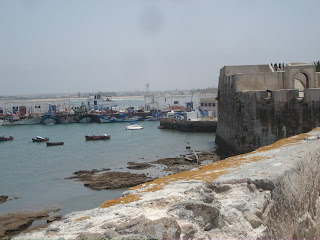 The main attraction in the city is the 'Cite Portugaise' which was built by the Portuguese as a fort to protect their port, and was called Mazagan by the Portuguese. The 'Cite Portugaise' is a UNESCO World Heritage Site, and is really interesting to walk around. There are two abandoned churches, and abandoned synagogue (all closed), and the main lighthouse of the fortified city has been converted into a minaret.
 Because El-Jadida is a port town, there's a lot of fish to be found. Fish of every kind, cooked in every way possible. Fish tajine, cumin spiced sardine balls in bread, fried fish. I tried a few of the types of fish, and from the photo you can see that one night I got more than my dose of Omega-3 Acids (this dinner was battered and fried sardine, calamari, and sole).
 There's a nice beach in El-Jadida, which is the other main attraction. The sand is really nice, and the beach pretty clean too. And of course they had the obligatory camel and/or horse on the beach that you could take for a ride for a minimal fee.
 El-Jadida is a costal city, which is much more popular with Moroccan tourists than it is with foreign tourists. Because there aren't tons of foreign tourists the city is less 'touristy' in the sense that there aren't stalls everywhere selling the same goods, and the locals are welcoming in a genuine way and aren't trying to sell you something,
  The main attraction in the city is the 'Cite Portugaise' which was built by the Portuguese as a fort to protect their port, and was called Mazagan by the Portuguese. The 'Cite Portugaise' is a UNESCO World Heritage Site, and is really interesting to walk around. There are two abandoned churches, and abandoned synagogue (all closed), and the main lighthouse of the fortified city has been converted into a minaret.
 Because El-Jadida is a port town, there's a lot of fish to be found. Fish of every kind, cooked in every way possible. Fish tajine, cumin spiced sardine balls in bread, fried fish. I tried a few of the types of fish, and from the photo you can see that one night I got more than my dose of Omega-3 Acids (this dinner was battered and fried sardine, calamari, and sole).
 There's a nice beach in El-Jadida, which is the other main attraction. The sand is really nice, and the beach pretty clean too. And of course they had the obligatory camel and/or horse on the beach that you could take for a ride for a minimal fee.
June 24, 2008
Casa...
 I spent one day in Casablanca, or Casa as it's known by the locals, which was plenty of time to see the city. The Arabic name for the city is Dar al-Baida, meaning "White House". It's famous mainly from the film 'Casablanca', which was shot entirely in California and not at all in Morocco.
 The original medina is really small, since it was only a village when the French arrived. So most of the city is a French 'invention', with lots of art deco buildings in various states of repair and disrepair. The medina itself has a lot of new buildings in it, and there isn't much of the wall left. The interesting buildings are the Art Deco buildings that the French built.
 The main 'tourist' site in Casablanca is the Hassan II Mosque, the world's 3rd largest mosque (and largest outside of Saudi Arabia). The mosque is so big that it could fit 25,000 people inside and another 80,000 in the courtyard (quick math = 105,000 people!). The minaret is the world's tallest at 210 metres. Quite incredible to see, and interesting because it's one of the very few mosques in Morocco that non-Muslims are allowed to enter (at a very high ticket price).
 I spent one day in Casablanca, or Casa as it's known by the locals, which was plenty of time to see the city. The Arabic name for the city is Dar al-Baida, meaning "White House". It's famous mainly from the film 'Casablanca', which was shot entirely in California and not at all in Morocco.
 The original medina is really small, since it was only a village when the French arrived. So most of the city is a French 'invention', with lots of art deco buildings in various states of repair and disrepair. The medina itself has a lot of new buildings in it, and there isn't much of the wall left. The interesting buildings are the Art Deco buildings that the French built.
 The main 'tourist' site in Casablanca is the Hassan II Mosque, the world's 3rd largest mosque (and largest outside of Saudi Arabia). The mosque is so big that it could fit 25,000 people inside and another 80,000 in the courtyard (quick math = 105,000 people!). The minaret is the world's tallest at 210 metres. Quite incredible to see, and interesting because it's one of the very few mosques in Morocco that non-Muslims are allowed to enter (at a very high ticket price).
Larache...
 After Chefchaouen I headed west to the small coastal city of Larache to meet up with two friends who lived with the same host family as me in Fez. I arrived in the afternoon, and by the evening we had wandered around most of the small port city. Larache has an interesting history though, as it was controlled by the Spanish in the 17th century, and became the main Spanish port city in Morocco in 1911. The city still has a Spanish consulate here, and a distinct Spanish flavour (which includes churros being sold in the main square, and a crumbling Spanish fort at the mouth of the harbour).
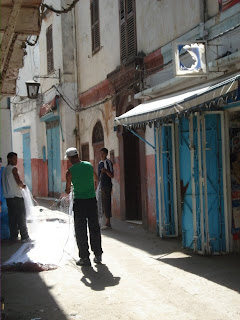 Larache still has a minor port, and lots of fish to go around. Not to mention a beach, Phoenician/Roman ruins, and a relaxed atmosphere. There are few tourists who come here, so it's a nice place to escape all the tourist touts of the bigger cities like Casa, Marrakech, and Fez. I've decided to eat well here, since food is less expensive than in the bigger cities. I've had my fill of some amazing pastries, pizza on the sea, an incredible fish, potato and tomato tajine (one of the top 3 tajines I've had in Morocco so far), and a bowl snails eaten with a safety pin from a dirt street vendor at dusk.
 Near to Larache is the ancient city of Lixus, which was founded by the Phoenicians and expanded by the Romans. It's not a huge city and hasn't been fully excavated, but it's cool in that you can wander through the ruins yourself without paying an admission. There's an amphitheatre, temple, baths, houses, ramparts and lots of stones strewn about.
 After Chefchaouen I headed west to the small coastal city of Larache to meet up with two friends who lived with the same host family as me in Fez. I arrived in the afternoon, and by the evening we had wandered around most of the small port city. Larache has an interesting history though, as it was controlled by the Spanish in the 17th century, and became the main Spanish port city in Morocco in 1911. The city still has a Spanish consulate here, and a distinct Spanish flavour (which includes churros being sold in the main square, and a crumbling Spanish fort at the mouth of the harbour).
 Larache still has a minor port, and lots of fish to go around. Not to mention a beach, Phoenician/Roman ruins, and a relaxed atmosphere. There are few tourists who come here, so it's a nice place to escape all the tourist touts of the bigger cities like Casa, Marrakech, and Fez. I've decided to eat well here, since food is less expensive than in the bigger cities. I've had my fill of some amazing pastries, pizza on the sea, an incredible fish, potato and tomato tajine (one of the top 3 tajines I've had in Morocco so far), and a bowl snails eaten with a safety pin from a dirt street vendor at dusk.
 Near to Larache is the ancient city of Lixus, which was founded by the Phoenicians and expanded by the Romans. It's not a huge city and hasn't been fully excavated, but it's cool in that you can wander through the ruins yourself without paying an admission. There's an amphitheatre, temple, baths, houses, ramparts and lots of stones strewn about.
June 22, 2008
Hammam...
 I decided to try a Moroccan bath while I was in Chefchaouen because it was right next to the hotel. Of course I got charged at least three times as much because I'm a tourist (30Dh compared to 8Dh). Hammams are open at different times (and rarely alternate days) for men and women.
There were three rooms at different temperatures and humidity levels, starting with the coolest and working to the warmest (but not hot) and most humid. Everyone gets one or two buckets, which can be filled from a main source (boiling hot and freezing cold water is mixed to the temperature you want) as many times as you want. There's a smaller scoop that you use to pour the water from the big buckets onto your body. I decided to try the gommage, which is basically a man who works at the hammam with a scratchy mitt who scrubs multiple layers of skin off you as hard as he can. The soap traditionally used in a hammam is made of olive and other products, and is great after having your skin peeled off. It's nice to feel clean at the end of a hot and sweaty day.
 I decided to try a Moroccan bath while I was in Chefchaouen because it was right next to the hotel. Of course I got charged at least three times as much because I'm a tourist (30Dh compared to 8Dh). Hammams are open at different times (and rarely alternate days) for men and women.
There were three rooms at different temperatures and humidity levels, starting with the coolest and working to the warmest (but not hot) and most humid. Everyone gets one or two buckets, which can be filled from a main source (boiling hot and freezing cold water is mixed to the temperature you want) as many times as you want. There's a smaller scoop that you use to pour the water from the big buckets onto your body. I decided to try the gommage, which is basically a man who works at the hammam with a scratchy mitt who scrubs multiple layers of skin off you as hard as he can. The soap traditionally used in a hammam is made of olive and other products, and is great after having your skin peeled off. It's nice to feel clean at the end of a hot and sweaty day.
June 21, 2008
Chefchaouen...
 My first stop after Fez was a city in the north called Chefchaouen. It's a beautiful city in the mountains, and the whole medina is painted various shades of blue and white. It was rather warm while I was there, and one day I drank 3 litres of water and still had a headache from dehydration and too much sun. I stayed at a small hotel, which was of course painted blue, right next to the main square and kasbah in the city.
 A two kilometre walk up the hill leads to a ruined mosque, which the Spanish built while they occupied the northern parts of Morocco. It was a nice walk, with a great view of the city from the hill that the mosque is on. That was an interesting thing I found in Chefchaouen that wasn't present in Fez or Meknes -the fact that a lot of people addressed me first in Spanish and then in French.
 Chefchaouen is in a valley surrounded by some beautiful mountains and hills. While walking up to the mosque I passed by several goatherders with small flocks of goats. The city was also interesting because there were a number of different berber groups that live/trade in the city, as is seen by the different types of headgear (colourful hats, or coloured clothes folded over the head, as opposed to the Arab headscarf).
 My first stop after Fez was a city in the north called Chefchaouen. It's a beautiful city in the mountains, and the whole medina is painted various shades of blue and white. It was rather warm while I was there, and one day I drank 3 litres of water and still had a headache from dehydration and too much sun. I stayed at a small hotel, which was of course painted blue, right next to the main square and kasbah in the city.
 A two kilometre walk up the hill leads to a ruined mosque, which the Spanish built while they occupied the northern parts of Morocco. It was a nice walk, with a great view of the city from the hill that the mosque is on. That was an interesting thing I found in Chefchaouen that wasn't present in Fez or Meknes -the fact that a lot of people addressed me first in Spanish and then in French.
 Chefchaouen is in a valley surrounded by some beautiful mountains and hills. While walking up to the mosque I passed by several goatherders with small flocks of goats. The city was also interesting because there were a number of different berber groups that live/trade in the city, as is seen by the different types of headgear (colourful hats, or coloured clothes folded over the head, as opposed to the Arab headscarf).
June 17, 2008
Fez...
 It's hard to believe, but I've been in Fez for three weeks now studying Arabic. During my time here, I've stayed with an amazing Berber family in the heart of the medina who has been incredibly welcoming. I know that if I were to stay in Fez for three weeks in a hotel, I would have had a totally different experience.
 Fez is the third largest city in Morocco, contains the world's oldest continually functioning university (Qarawiyyin), and the old medina where I lived is a UNESCO World Heritage Site. Apart from that, Fez is one of the four Royal Cities in Morocco, along with Meknes, Rabat, and Marrakech). The city itself is quite interesting to just wander around. Of course there's a bit of hassle from the shop keepers who all want you to take a look or buy something from their shop, but it's a lot less then I expected.
 Fez is famous for a number of things, including the tanneries where they turn animal hide into leather of all sorts of colour. The whole process is done naturally, in huge vats of chemicals (including pigeon excriment) and natural dyes, by people who have learned the trade from their fathers/uncles. The process does smell a bit, though it's not too bad if you go in the afternoon.
 The city is great to just wander around, and get lost in (which is rather easy to do). The old city is totally surrounded by the original/repaired medieval wall, which helps a bit with the navigation.
 I've enjoyed my three weeks in Fez, and I know that I'll be back ('Insha-allah' as they say here) when I have the chance. I'm now off to explore other parts of Morocco, including the coast and Marrakech.
 It's hard to believe, but I've been in Fez for three weeks now studying Arabic. During my time here, I've stayed with an amazing Berber family in the heart of the medina who has been incredibly welcoming. I know that if I were to stay in Fez for three weeks in a hotel, I would have had a totally different experience.
 Fez is the third largest city in Morocco, contains the world's oldest continually functioning university (Qarawiyyin), and the old medina where I lived is a UNESCO World Heritage Site. Apart from that, Fez is one of the four Royal Cities in Morocco, along with Meknes, Rabat, and Marrakech). The city itself is quite interesting to just wander around. Of course there's a bit of hassle from the shop keepers who all want you to take a look or buy something from their shop, but it's a lot less then I expected.
 Fez is famous for a number of things, including the tanneries where they turn animal hide into leather of all sorts of colour. The whole process is done naturally, in huge vats of chemicals (including pigeon excriment) and natural dyes, by people who have learned the trade from their fathers/uncles. The process does smell a bit, though it's not too bad if you go in the afternoon.
 The city is great to just wander around, and get lost in (which is rather easy to do). The old city is totally surrounded by the original/repaired medieval wall, which helps a bit with the navigation.
 I've enjoyed my three weeks in Fez, and I know that I'll be back ('Insha-allah' as they say here) when I have the chance. I'm now off to explore other parts of Morocco, including the coast and Marrakech.
June 14, 2008
Fez Sacred Music Festival...
 The Festival de Fes des musiques sacrees du monde (Fez World Sacred Music Festival) is taking place in Fez until the 16th of June. Part of my reason for chosing to study in Fez during June, was to be able to attend some of the festival. Most of the concerts require tickets, but there are still a fair number of free concerts throughout the city.
I saw a great concert the other night by a group of Tauregs from Timbuktu, Mali. I made two short videos, and although the quality isn't great, the music is amazing. The concert was outside at Dar Tazi, and old house with a beautiful courtyard where the concert was held. The group played on a low stage, and the audience sat on the ground on carpets. The evening concerts start at 23h, so it's dark out, and there's a cool breeze after the heat of the day.
A few nights earlier there was an amazing Qawwali concert by a group from Pakistan who also played at Dar Tazi.
In addition to the free evening concerts, there's also a huge square that has free afternoon concerts at Bab BouJloud. This is probably the most popular set of concerts, because they're free and most Moroccans don't have 400Dh (40Euro) to spare for a concert ticket
 Along with the free and paid concerts, there are also a few photography exhibits around town as part of the "Rencontres internationales de la photo". There was an amazing exhibit called "Sons of Abraham" by a photographer named Abbas from Iran.
 The Festival de Fes des musiques sacrees du monde (Fez World Sacred Music Festival) is taking place in Fez until the 16th of June. Part of my reason for chosing to study in Fez during June, was to be able to attend some of the festival. Most of the concerts require tickets, but there are still a fair number of free concerts throughout the city.
I saw a great concert the other night by a group of Tauregs from Timbuktu, Mali. I made two short videos, and although the quality isn't great, the music is amazing. The concert was outside at Dar Tazi, and old house with a beautiful courtyard where the concert was held. The group played on a low stage, and the audience sat on the ground on carpets. The evening concerts start at 23h, so it's dark out, and there's a cool breeze after the heat of the day.
A few nights earlier there was an amazing Qawwali concert by a group from Pakistan who also played at Dar Tazi.
In addition to the free evening concerts, there's also a huge square that has free afternoon concerts at Bab BouJloud. This is probably the most popular set of concerts, because they're free and most Moroccans don't have 400Dh (40Euro) to spare for a concert ticket

 Along with the free and paid concerts, there are also a few photography exhibits around town as part of the "Rencontres internationales de la photo". There was an amazing exhibit called "Sons of Abraham" by a photographer named Abbas from Iran.
Subscribe to:
Posts (Atom)